Enhancing Agricultural Resilience Through Seed Priming: A Review
Vijay Kumar
Division of Agronomy, Sher-e-Kashmir University of Agricultural Sciences and Technology of Jammu, Chatha, J&K (UT), 180 009, India.
Vivek Bhagat *
Division of Agronomy, Sher-e-Kashmir University of Agricultural Sciences and Technology of Jammu, Chatha, J&K (UT), 180 009, India.
Kedar Mahadev Gheware
Division of Floriculture and Landscaping, Sher-e-Kashmir University of Agricultural Sciences and Technology of Jammu, Chatha, J&K (UT), 180 009, India.
Chanchal
Division of Agricultural Extension Education, Sher-e-Kashmir University of Agricultural Sciences and Technology of Jammu, Chatha, J&K (UT), 180 009, India.
Banti
Division of Agronomy, Sher-e-Kashmir University of Agricultural Sciences and Technology of Jammu, Chatha, J&K (UT), 180 009, India.
Atul Kumar
Division of Agricultural Extension Education, Sher-e-Kashmir University of Agricultural Sciences and Technology of Jammu, Chatha, J&K (UT), 180 009, India.
Kamaldeep Kaur
Sant Baba Bhag Singh University, Jalandhar, Punjab, 144030, India.
*Author to whom correspondence should be addressed.
Abstract
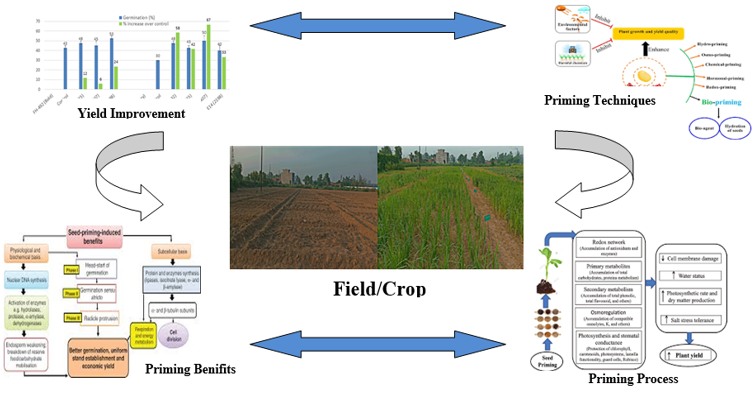
Seed priming is an innovative pre-sowing technique that enhances germination, seedling emergence, and crop resilience, offering significant potential for addressing modern agricultural challenges. This review examines various seed priming methods, including hydropriming, osmotic priming, halo-priming, and nanopriming, and their application across diverse crops. These techniques enable seeds to withstand abiotic stresses such as drought, salinity, and heat, which are increasingly critical due to climate change and resource limitations. Research highlights the effectiveness of hydropriming in wheat, where soaking seeds in water enhances germination rates and uniformity, particularly under saline conditions. Similarly, halopriming with potassium nitrate (KNO₃) or sodium chloride (NaCl) solutions improves salt stress resilience in tomato plants, increasing root length and seedling vigor. These findings illustrate the ability of seed priming to support crop establishment in challenging environments, including arid and semi-arid regions. Seed priming also offers broader agricultural and environmental benefits. Techniques like on-farm priming are cost-effective, eco-friendly, and accessible to farmers with limited resources, making advanced practices more widely adoptable. By reducing reliance on chemical inputs and enhancing resistance to soil-borne diseases, seed priming promotes sustainable farming practices. Moreover, advanced methods such as nanopriming provide precise delivery of nutrients and growth agents, opening avenues for more efficient agriculture. Future research should focus on optimizing priming protocols for specific crops and environments, assessing long-term impacts on yield, soil health, and crop quality, and developing solutions tailored to climate extremes and marginal lands. Additionally, exploring biopriming with beneficial microorganisms could further enhance plant health and resilience. Seed priming is a transformative agricultural tool with the potential to boost productivity, mitigate the impacts of climate change, and ensure food security. Expanding its adoption through strategic research, supportive policies, and farmer education will be critical to maximizing its global impact.
GRAPHICAL ABSTRACT
Keywords: Seed priming, priming techniques, benefits, cereals, vegetable, fruit crops