Mechanism and Modulation of Photoreceptor Dynamics in Plant Light Sensing
Monika Kumari
Division of Plant Physiology, SKUAST-J, Chatha, 180009, India.
Gurdev Chand
Division of Plant Physiology, SKUAST-J, Chatha, 180009, India.
B.K. Sinha
Division of Plant Physiology, SKUAST-J, Chatha, 180009, India.
Swati
Division of Plant Physiology, SKUAST-J, Chatha, 180009, India.
Jyotsana Kalsi
Division of Plant Physiology, SKUAST-J, Chatha, 180009, India.
Mandeep Kour
Division of Plant Physiology, SKUAST-J, Chatha, 180009, India.
Radheysham Kumawat
College of Post Graduate Studies in Agricultural Sciences, Central Agricultural University (Imphal), Umiam-793103, Meghalaya, India.
Sapalika Dogra
Faculty of Agriculture, Division of Basic Sciences and Humanities, SKUAST-K, India.
Ritika Gupta
FSR center, SKUAST-J, Chatha, 180009, India.
Kanik Kumar Bansal *
Guru kashi university, Bathinda, Punjab, India.
*Author to whom correspondence should be addressed.
Abstract
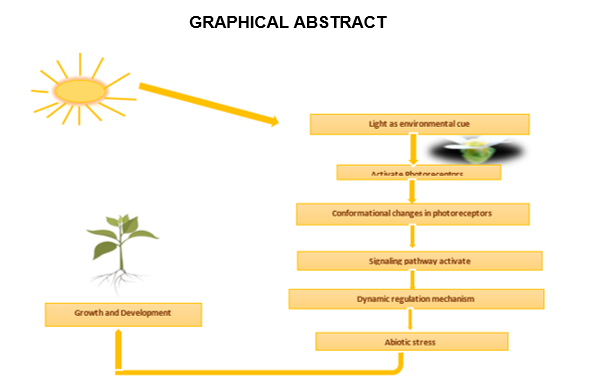
Light serves as the main environmental cue for plants, and they use photoreceptors to detect and respond to variations in light intensity. Plants can maximize growth, development, and survival by use of photoreceptor proteins, which include phytochromes, cryptochromes, and phototropins. These proteins mediate responses to red, blue, and UV light. Such photoreceptors go through conformational changes upon absorbing light, which trigger signalling cascades and gene expression alterations. A key aspect of this process is the dynamic regulation of photoreceptor activity, ensuring that plants can fine-tune their responses to fluctuating light conditions. Mechanisms such as receptor degradation, reversible phosphorylation, nuclear translocation, and interactions with other signalling proteins modulate photoreceptor function, contributing to the precise control of downstream responses. Plants are able to adapt variations in light levels and seasons because environmental factors have an impact on photoreceptor dynamics, including light intensity, duration, and wavelength composition. Also, recent research has highlighted the control of photoreceptor stability and signalling efficacy by post-translational modifications and protein-protein interactions. Recognizing these dynamic mechanisms is crucial for comprehending how plants integrate connection between light signals and other environmental indicators, like water supply and temperature. Modulating photoreceptor dynamics presents opportunities for improving crop productivity and resilience. By unravelling the molecular underpinnings of light sensing, scientists can potentially manipulate photoreceptor activity to optimize growth in suboptimal light environments, providing strategies for agricultural sustainability in the context of climate change. This review examines the latest developments in plant light sensing mechanisms and photoreceptor dynamics regulation, as well as the wider implications for plant biology.
Keywords: Photoreceptors, cryptochrome, light sensing, post-translational modifications