Mitigating Aquatic Toxicity through the Use of Aquatic Plants
Sitanshu Sekhar Satapathy
Department of Botany, C.V. Raman Global University, Bhubaneswar, 752054, India.
Jagyaswani Nayak
Department of Botany, C.V. Raman Global University, Bhubaneswar, 752054, India.
Neelanjana Choudhury
*

Department of Biotechnology, C.V. Raman Global University, Bhubaneswar, 752054, India.
Soumyashreee Dash
Department of Biotechnology, C.V. Raman Global University, Bhubaneswar, 752054, India.
Afreen Anis
Department of Biotechnology, C.V. Raman Global University, Bhubaneswar, 752054, India.
Subhashree Sahu
Department of Biotechnology, C.V. Raman Global University, Bhubaneswar, 752054, India.
D Swapna
Department of Biotechnology, C.V. Raman Global University, Bhubaneswar, 752054, India.
Barsharani Sethi
Department of Biotechnology, C.V. Raman Global University, Bhubaneswar, 752054, India.
Bishnupriya Nayak
Department of Biotechnology, C.V. Raman Global University, Bhubaneswar, 752054, India.
Barsharani Naik
Department of Biotechnology, C.V. Raman Global University, Bhubaneswar, 752054, India.
*Author to whom correspondence should be addressed.
Abstract
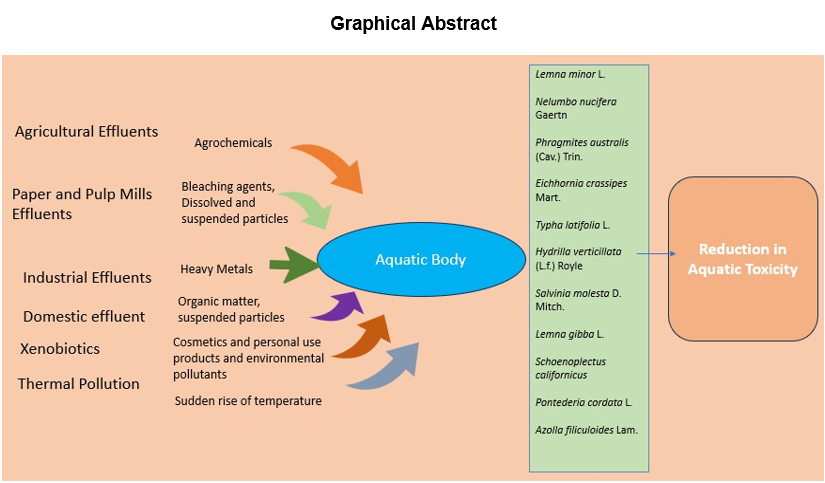
Aquatic ecosystems are increasingly threatened by pesticides, industrial chemicals, and urban runoff. These toxicants accumulate in water bodies, affecting biodiversity. Aquatic plants play a crucial role in mitigating this pollution. Species like Lemna gibba detoxify phenolic compounds, while Eichhornia crassipes metabolize PCP, making them effective in wastewater treatment. Techniques like phytoremediation (using aquatic plants to remediate the contaminated water bodies), phytoaccumulation (uptake the heavy metals and toxic elements by roots of plants), rhizofilteration (absorbs the contaminants by the roots in the highly toxic aqueous ecosystem) perform in both aquatic and terrestrial systems, algal turf scrubber (ATS) removal of organic pollutants and concentrated nutrients by using filamentous algae, constructed wetlands which are the copies of wetlands to treat the natural wetlands by using aquatic plant species like Typha spp., Phragmites spp., etc. There are so many aquatic plant species that have a natural ability to absorb or break down the toxic elements and metabolites in aquatic environments. The study focuses on how, using these plants may reduce the toxicity of aquatic ecosystems and allow wastewater management to be done naturally and effectively.
Keywords: Aquatic toxicity, phytoremediation, toxicity-reducing plants, wastewater treatment, bioindicators