Effect of Different Growing Substratum on Physio-morphological and Biochemical Parameters of Cucumber (Cucumis sativus L.) under Soilless Condition
Shruti Verma
Division of Plant Physiology, Sher-e-Kashmir University of Agricultural Sciences and Technology, Chatha-180009, Jammu & Kashmir, India.
Gurdev Chand
Division of Plant Physiology, Sher-e-Kashmir University of Agricultural Sciences and Technology, Chatha-180009, Jammu & Kashmir, India.
Jyotsana Kalsi
Division of Plant Physiology, Sher-e-Kashmir University of Agricultural Sciences and Technology, Chatha-180009, Jammu & Kashmir, India.
B.K. Sinha
Division of Plant Physiology, Sher-e-Kashmir University of Agricultural Sciences and Technology, Chatha-180009, Jammu & Kashmir, India.
Monika Kumar
Division of Plant Physiology, Sher-e-Kashmir University of Agricultural Sciences and Technology, Chatha-180009, Jammu & Kashmir, India.
Ankita Raina
Division of Plant Physiology, Sher-e-Kashmir University of Agricultural Sciences and Technology, Chatha-180009, Jammu & Kashmir, India.
Sofia Malpotra
Division of Plant Physiology, Sher-e-Kashmir University of Agricultural Sciences and Technology, Chatha-180009, Jammu & Kashmir, India.
Mandeep Kaur
Division of Plant Physiology, Sher-e-Kashmir University of Agricultural Sciences and Technology, Chatha-180009, Jammu & Kashmir, India.
Swati
Division of Plant Physiology, Sher-e-Kashmir University of Agricultural Sciences and Technology, Chatha-180009, Jammu & Kashmir, India.
Marvi Sharma
Division of Plant Physiology, Sher-e-Kashmir University of Agricultural Sciences and Technology, Chatha-180009, Jammu & Kashmir, India.
Kanik Kumar Bansal *
Guru Kashi University, Bathinda, Punjab-151302, India.
*Author to whom correspondence should be addressed.
Abstract
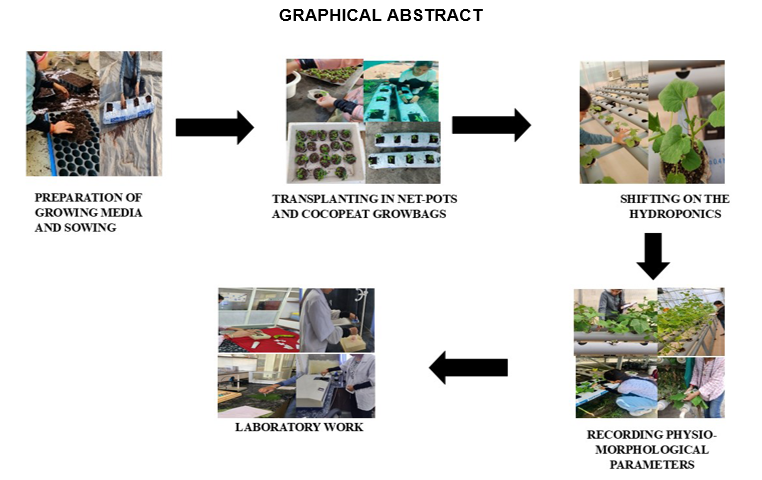
The present investigation was conducted to determine the effects of different growing media on physio-morphological and biochemical measures of cucumber under hydroponics and growbags. Two cucumber varieties were selected viz. desi kheera and hybrid cucumber. There were five treatments i.e. T1: cocopeat (100%) control, T2: cocopeat + perlite (2:1), T3: cocopeat+ perlite+ vermiculite (2:1:1), T4: cocopeat + perlite + vermiculite + vermicompost (2:1:1:2) and T5: cocopeat growbags without husk. The seeds were sown in the pro-trays filled with the cocopeat and vermicompost growing media. After 15 days these seedlings were shifted in the net-pots containing different treatment combinations of growing media up to T4 and for T5, the seedlings were shifted in growbags and after two days, the seedlings in the net-pots were transplanted in the hydroponics Nutrient Flim Technique system. The morphological, physiological and biochemical parameters were observed at 20, 45 and 90 days after transplanting (DAT). The results showed that the shoot length showed the significantly higher values in plants growing in treatment T4 (127.03 cm and 125.37 cm), the total chlorophyll content by SPAD showed the significantly increased values in T4 growing plants (47.80 and 46.30) and also the values of total soluble solids showed the significantly higher values in T4 growing plants (3.83 0 Brix and 3.60 0 Brix) in both varieties as compared to the cucumber plants growing in treatment T1. Also, the values of total chlorophyll (mg/g FW) and ascorbic acid (mg/100g FW) showed the significantly higher values in leaves and fruits of plants growing in treatment T4 (1.75 mg/g FW and 1.58 mg/g FW) & (6.88 mg/100g FW and 6.01 mg/100g FW) respectively as compared to treatment T1. Therefore, plants growing in treatment T4 showed the best results among all the treatments and desi kheera showed the best results between both the varieties.
Keywords: Cucumis sativus, hydroponics, growing media, net-pots, cocopeat growbags