Comparative Economic Analysis of Saffron (Crocus sativus L.) Cultivation under Hydroponic and Conventional Systems across Different Agro-Climatic Zones of Jammu and Kashmir
Marvi Sharma *
Division of Plant Physiology, Faculty of Basic Sciences, SKUAST-J, India.
Gurdev Chand
Division of Plant Physiology, Faculty of Basic Sciences, SKUAST-J, India.
Bhav Kumar Sinha
Division of Plant Physiology, Faculty of Basic Sciences, SKUAST-J, India.
Sapalika Dogra
Division of Plant Physiology, Faculty of Basic Sciences, SKUAST-K, India.
Vishali Dalgotra
Division of Plant Physiology, Faculty of Basic Sciences, SKUAST-J, India.
Farzana Kousar
Division of Plant Physiology, Faculty of Basic Sciences, SKUAST-J, India.
Divya Sharma
Division of Plant Physiology, Faculty of Basic Sciences, SKUAST-J, India.
Mandeep Kour
Division of Plant Physiology, Faculty of Basic Sciences, SKUAST-J, India.
Monika Kumari
Division of Plant Physiology, Faculty of Basic Sciences, SKUAST-J, India.
Jyotsana Kalsi
Division of Plant Physiology, Faculty of Basic Sciences, SKUAST-J, India.
Swati
Division of Plant Physiology, Faculty of Basic Sciences, SKUAST-J, India.
Disha Sharma
Division of Plant Physiology, Faculty of Basic Sciences, SKUAST-J, India.
Shreya Parihar
Division of Plant Physiology, Faculty of Basic Sciences, SKUAST-J, India.
Abhishek Kumar
Division of Plant Physiology, Faculty of Basic Sciences, SKUAST-J, India.
Mahmood Mustaq
Division of Plant Physiology, Faculty of Basic Sciences, SKUAST-J, India.
*Author to whom correspondence should be addressed.
Abstract
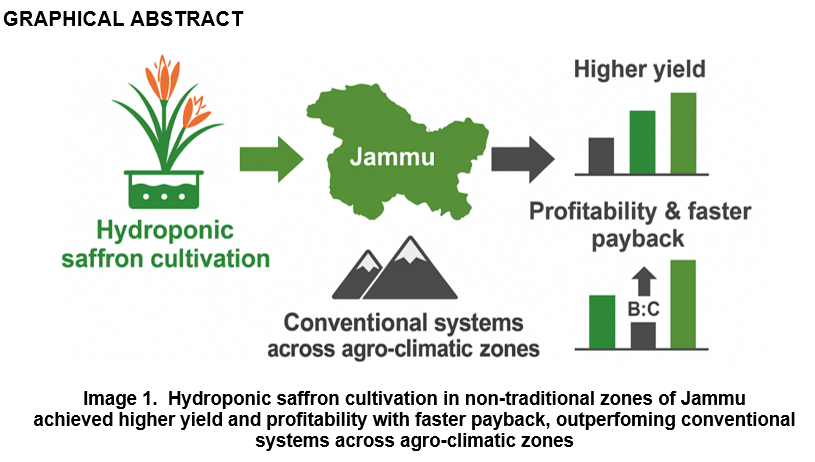
Saffron (Crocus sativus L.), a premium spice crop traditionally cultivated in Kashmir and Kishtwar, faces economic limitations under conventional systems due to stagnant yields, rising input costs, and climatic uncertainties. This study evaluates the economic feasibility of hydroponic saffron cultivation as an alternative model, comparing input costs, yields, and profitability against conventional practices across three agro-climatic zones of Jammu and Kashmir. Field experiments conducted during 2023–24 used a completely randomized design, with two-year hydroponic trials in Jammu and conventional plots in Kashmir and Kishtwar. Results showed that hydroponic systems achieved significantly higher stigma yields (5500–6000 g·ha⁻¹) than conventional systems (3200–3500 g·ha⁻¹), while reducing recurring costs in the second year by over 85 %. The benefit–cost ratio in hydroponics increased from 3.74 (Year 1) to 26.67 (Year 2), compared to 1.84–2.12 in conventional systems. Payback period analysis revealed that hydroponic capital investments were recovered within the first cropping cycle. Principal Component Analysis (PCA) further confirmed hydroponic Year 2 as the most economically efficient treatment. Sensitivity analysis showed robust profitability even at lower yield levels. These findings highlight hydroponic saffron cultivation as a scalable, climate-resilient, and economically superior strategy aligned with sustainable development goals, offering new opportunities for high-value agriculture in non-traditional zones of Jammu & Kashmir.
Keywords: Hydroponics, economic analysis, benefit–cost ratio, PCA, sustainable agriculture