Microplastic Pollution in Agricultural Soils and Freshwater Ecosystem of Northeast India: Current Status, Pathways, and Knowledge Gaps
Ghanashyam Singh Yurembam
Department of Soil and Water Conservation Engineering, CAEPHT, Ranipool, Sikkim, India.
N Bidyarani Chanu *
Department of Soil and Water Conservation Engineering, CAEPHT, Ranipool, Sikkim, India.
Saya D
Department of Soil and Water Conservation Engineering, CAEPHT, Ranipool, Sikkim, India.
D. Jhajharia
Department of Soil and Water Conservation Engineering, CAEPHT, Ranipool, Sikkim, India.
Y. Ranjana Devi
Directorate of Instructions, CAU, Imphal, India.
G.T. Patle
Department of Soil and Water Conservation Engineering, CAEPHT, Ranipool, Sikkim, India.
*Author to whom correspondence should be addressed.
Abstract
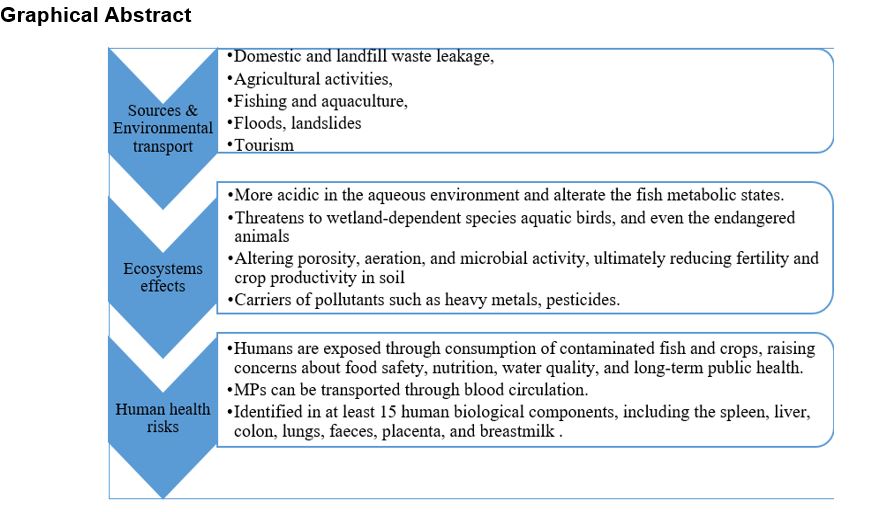
Aim: Microplastics contamination is an escalating environmental threat in Northeast India, critically impacting its fragile ecosystems, agriculture, and public health. The region, recognized as a global biodiversity hotspot, faces growing microplastics pollution from diverse sources such as domestic waste, agriculture, industrial activities, and aquaculture. This study explores the comprehensive understanding that can guide future research, governance, and regional mitigation strategies.
Objective: This review aims to synthesize existing research on microplastics contamination in Northeast India, assess their sources and environmental pathways, evaluate ecological and agricultural impacts, identify critical knowledge gaps, and highlight policy and community-level interventions required for effective management. This review uniquely integrates freshwater–soil linkages, monsoon-driven transport mechanisms, and region-specific policy challenges within the Eastern Himalayan context.
Methodology: The review compiles and analyzes available scientific literature, government reports, and regional environmental assessments related to microplastics contamination in Northeast India. A comprehensive search was conducted from 2020 to 2025 using major scientific databases, including Web of Science, Scopus, Google Scholar, and PubMed. Studies focusing on freshwater ecosystems, soils, biodiversity impacts, and regional waste-management practices were systematically evaluated.
Results: Microplastics are commonly found in freshwater systems and agricultural soils, highlighting widespread contamination. Freshwater ecosystems often contain higher levels of microplastics, with significant biological uptake in fish and other aquatic organisms, suggesting potential for trophic transfer and bioaccumulation. In agricultural soils, contamination is linked to practices like plastic mulching, irrigation infrastructure, and land use. Despite these growing concerns, research efforts remain limited and inconsistent, with a lack of standardized methodologies and long-term monitoring.
Significance: This review highlights the urgent need for comprehensive monitoring, standardized assessment techniques, and targeted policy action to address microplastics contamination in Northeast India.
Keywords: Agriculture, microplastic, northeast, soil, wetland