Enhancing Yield, Quality, and Stability of Essential Oils by Application of Pulse Electric Field (PEF): A Review
Priyanshi Maheshwari
Department of Food Science and Technology, College of Agriculture, GBPUA&T, Pantnagar, Uttarakhand, India.
Satish Kumar Sharma
Department of Food Science and Technology, College of Agriculture, GBPUA&T, Pantnagar, Uttarakhand, India.
Sristi Vats
Department of Food Science and Technology, College of Agriculture, GBPUA&T, Pantnagar, Uttarakhand, India.
Charu Bisht
Department of Food Science and Technology, College of Agriculture, GBPUA&T, Pantnagar, Uttarakhand, India.
Seema Singh *
Department of Food Science and Technology, College of Agriculture, GBPUA&T, Pantnagar, Uttarakhand, India.
Akash Deep Shukla
Department of Food Science and Technology, College of Agriculture, GBPUA&T, Pantnagar, Uttarakhand, India.
Archana Gangwar
Department of Food Science and Technology, College of Agriculture, GBPUA&T, Pantnagar, Uttarakhand, India.
*Author to whom correspondence should be addressed.
Abstract
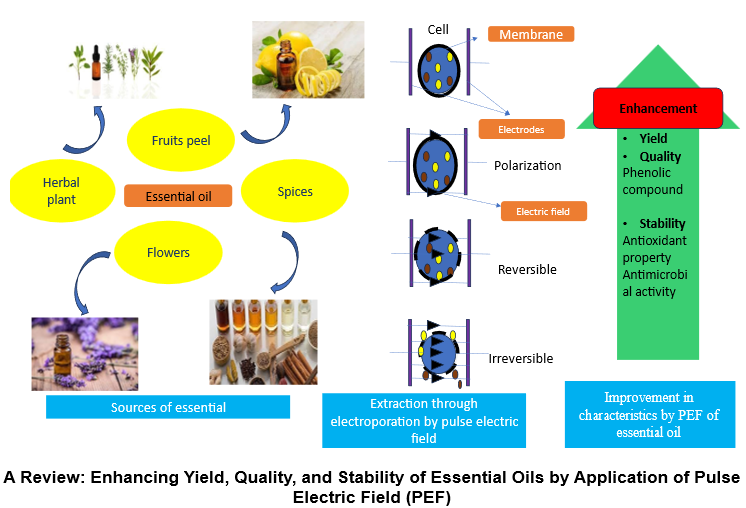
Essential oils are widely used across various industries due to their aromatic and volatile nature, and maintaining their bioactive integrity during processing is essential for preserving their commercial value. However, conventional extraction methods often involve prolonged processing times and may lead to chemical degradation of sensitive compounds. Pulsed Electric Field (PEF) technology has emerged as a promising alternative, as it enhances cell membrane electroporation, facilitates mass transfer, and enables efficient release of intracellular constituents while preserving the natural composition and oxidative stability of essential oils. In several cases, PEF has been reported to increase extraction yield by up to threefold compared to conventional hydrodistillation. Furthermore, combining PEF with mild heat treatment can improve both product quality and microbial safety. Studies on plants such as Rosa damascena, Eucalyptus, Thyme, Marrubium, and coriander demonstrate that PEF not only enhances extraction yield but also increases key constituents, including total phenolics, terpenes, and antioxidant compounds. Additionally, PEF contributes to reduced environmental impact through lower energy consumption and emissions. Future research should focus on large-scale optimization and techno-economic evaluation to facilitate industrial implementation. Overall, PEF represents a sustainable and efficient approach for industrial-scale essential oil production.
Graphical Abstract
Keywords: Pulse electric field, essential oil (EOs), extraction, total phenolic compound, stability