Innovations in Pollination Methods: Transition towards Modern Pollination in Precision Agriculture
N. Vairam
Department of Agricultural Engineering, SRM Valliammai Engineering College, Kattankulathur, Chengalpattu, India.
N. Murugan *
Department of Entomology, SRM College of Agricultural Sciences, Baburayenpettai, Chengalpattu, India.
*Author to whom correspondence should be addressed.
Abstract
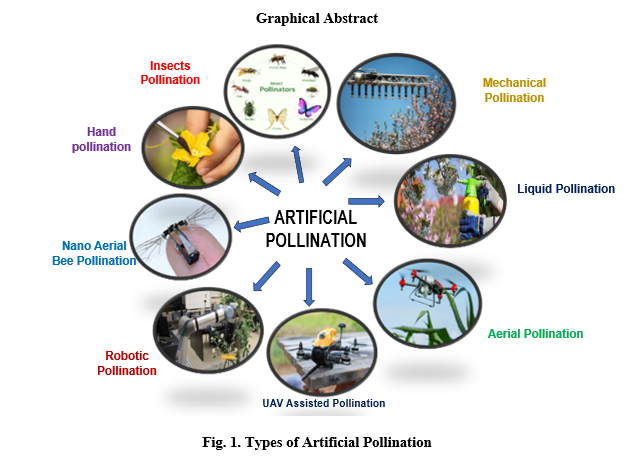
Pollination is a critical ecological process that directly influences global food production, biodiversity, and ecosystem stability. Traditional pollination methods—primarily reliant on natural pollinators such as bees, butterflies and manual human-assisted techniques—have supported agriculture for centuries. However, rapid declines in pollinator populations, intensification of farming systems, and the growing demand for higher crop yields have accelerated the shift toward innovative and technologically advanced pollination strategies. This review examines the evolution of pollination approaches from conventional practices to modern precision agriculture techniques. The present review was conducted using secondary sources derived from existing academic literature, including peer-reviewed journal articles, books, and conference proceedings. It highlights recent advancements, including mechanical pollinators, drone-assisted pollination, artificial intelligence–based flower detection, robotic micro-pollinators, and controlled-environment pollination systems used in protected cultivation. Furthermore, the abstract synthesises insights on the efficacy, scalability, ecological impacts, and economic feasibility of these innovations. By integrating traditional knowledge with cutting-edge technologies, precision pollination offers promising avenues for sustainable crop production, climate resilience, and enhanced food security. Future advancements are expected to focus on reducing research and development costs while enhancing the supporting infrastructure of pollination systems to achieve greater cost-effectiveness. The integration of image sensors with diverse pollination technologies is improving adaptability and efficiency across a wide range of greenhouse crops. These technological developments are accelerating the pollination process while simultaneously addressing economic constraints, thereby supporting the broader adoption of automated pollination solutions in modern agriculture. Overall, this review underscores the need for interdisciplinary research, farmer-friendly innovations, and policy support to ensure the future of pollination in modern agriculture.
Keywords: Pollination, mechanization, smart pollination, UAV assisted, precision farming