Host Plant-dependent Variation in Growth and Developmental Traits of Spodoptera litura (Fabricius)
Nikhitha Gangavarapu
Department of Entomology, University of Nebraska-Lincoln, Lincoln, NE 68583, United States and Department of Agricultural Entomology, Institute of Agriculture, Visva-Bharati, Sriniketan, 731236, India.
S. Bhattacharya *
Department of Agricultural Entomology, Institute of Agriculture, Visva-Bharati, Sriniketan, 731236, India.
D. S. Dhakre
Department of Agricultural Statistics, Visva-Bharati University, Institute of Agriculture, Visva-Bharati, Sriniketan, 731236, India.
S. Pal
Department of Agricultural Entomology, Institute of Agriculture, Visva-Bharati, Sriniketan, 731236, India and ASO Machmara, Department of Agriculture and Farmers’ Welfare, Unakoti, Tripura, India.
*Author to whom correspondence should be addressed.
Abstract
Background and Aims: Spodoptera litura is a major polyphagous pest causing significant economic losses across diverse crops. This study evaluated the influence of different host plants on developmental biology and morphometric characteristics of S. litura to identify hosts affecting pest performance for sustainable management strategies.
Study Design: The experiment was conducted in a Completely Randomized Design (CRD) with five treatments (host plants) and 20 replications per treatment (n = 100 total larvae).
Place and Duration of Study: The experiment was conducted in the Department of Agricultural Entomology, Institute of Agriculture, Visva-Bharati, Sriniketan, West Bengal, India, during 2023-24 under controlled laboratory conditions.
Methodology: Five host plants viz; castor, cabbage, mustard, brinjal, and red gram were cultivated organically for feeding S litura larvae. Egg masses collected from naturally infested castor plants were used to establish a laboratory colony. Individual larvae were reared separately in ventilated plastic containers under controlled conditions. Fresh leaves were provided daily, and containers were cleaned regularly to maintain hygiene. Morphometric parameters and developmental durations of different life stages were recorded daily using standard measuring methods, while pupae and adults were observed for sex determination and longevity studies. Data were analyzed using one-way ANOVA in Jamovi software, and significant differences among treatments were compared using Tukey’s HSD test at p < 0.05.
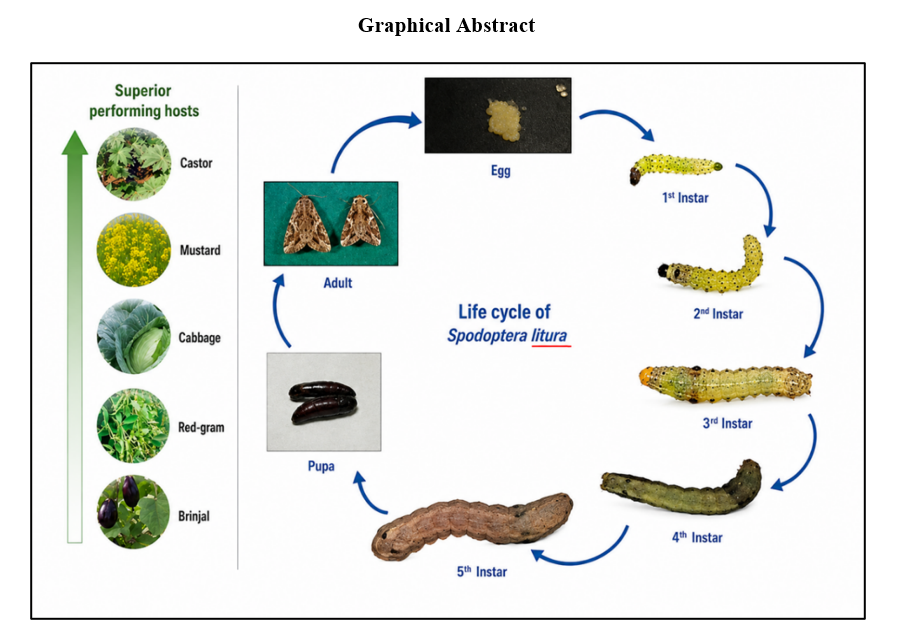
Results: Development and morphometrics varied significantly across host plants. Castor-fed larvae showed optimal overall performance with the shortest lifecycle (30.35 ± 2.27 days), while cabbage supported the fastest larval development but the longest 5th instar larvae (3.8595 ± 0.06 cm). Red gram and brinjal extended larval periods and produced smaller adults. Mustard-fed larvae had the longest total lifecycle (41.65 ± 0.34 days) but the highest adult longevity (9.3 ± 0.14 days). This study demonstrated that host plant selection significantly affects the developmental biology and morphometric traits of Spodoptera litura, with castor supporting optimal growth and rapid development, while red gram and brinjal resulted in slower development and reduced body size.
Conclusion: Poor-performing hosts such as red gram and brinjal may be incorporated into crop rotation or trap-cropping strategies to suppress Spodoptera litura populations and support sustainable pest management. Further studies are needed to understand the biochemical basis of host plant effects and validate these findings under field conditions for effective integrated pest management applications.
Keywords: Biological performance, morphometric traits, polyphagy, Spodoptera litura